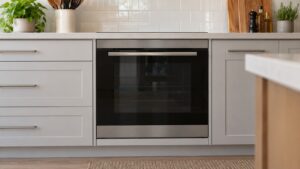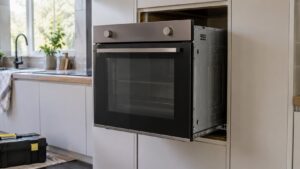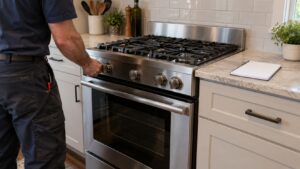
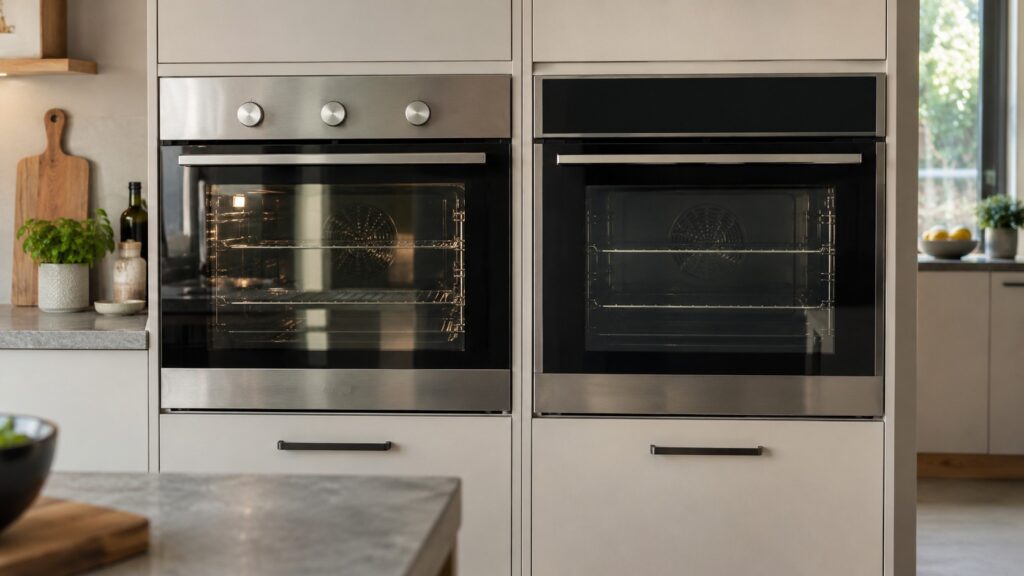
Choosing between a Bertazzoni gas oven vs electric oven comes down to what your kitchen can supply, how you cook and what you want to maintain. A gas oven heats with a burner and needs a gas line in the right place. An electric oven heats with elements and needs a suitable electrical circuit. Both still need electricity for the controls and, in a gas oven, for the igniter. Which one suits you is decided first by the connections available behind the cabinet and then by cooking habits; the exact specifications of any model are in its manual and on its rating label.
What is the real difference between a gas and an electric oven?
The difference is the source of heat. In a gas oven, a burner at the bottom of the cavity heats the air. The control lights it with an igniter, and a safety device checks the flame; our guide on how the flame safety works explains that sequence in general terms. In an electric oven, heating elements do the same job, and a temperature sensor and control cycle them on and off. Many ovens of both kinds add a convection fan to move the hot air around.
Some cooks have strong preferences between the two. We would not promise either result for a specific Bertazzoni model, because results depend on the oven’s design, the mode you use and the dish. If baking performance is the deciding factor, read your model’s manual for the available modes and how they behave.
Which does your kitchen support?
This is the first and often final question. A gas oven needs a gas supply at the right position and a way to connect it safely, and an electric oven needs a circuit of the right rating and a correct connection. If you are replacing an existing oven with the same fuel, the connection is already there. If you want to switch, someone qualified must run a new gas line or a new circuit, and that work should be quoted before you decide. Never connect or move a gas line yourself.
Our oven installation checks that prevent faults guide covers general points to confirm, and our range vs rangetop and wall oven guide helps you decide on the format. Choose the model first, then confirm the opening and connections against its installation instructions, not the other way round.
What about a dual fuel range?
A dual fuel range pairs a gas cooktop with an electric oven, so it is a middle path for cooks who want a flame on top and an electric oven below. It needs both connections. Our guide on dual fuel range faults, top vs oven explains why it helps to know which half is failing. This page is about the oven itself, so if the top is the question, see that guide and our range terms glossary.
Keep in mind that the oven side of a dual fuel range behaves like an electric oven, and the top behaves like gas. Each part brings the care and the faults of its own type.
How do the two differ when something goes wrong?
The faults differ because the parts differ. A gas oven that will not heat is often an ignition problem: a weak igniter, a gas valve that does not open, a safety device or a control. An electric oven that will not heat tends to point at a bake or broil element, a sensor, a relay or the control. In both cases the same first checks apply: is the display lit, is the breaker on, and is the door closed and the mode set. Our pages on oven not heating and range oven not heating describe the symptom for both.
The safety rules differ too. With a gas oven, a smell of gas means you leave and call from outside; you do not switch anything on or off. With an electric oven, sparks, a burning smell or water near the supply mean switching the breaker off while standing on a dry floor. In neither case should you open panels, and neither is an owner repair.
What should you check before you buy?
Write down the connection you have, the width of the opening and whether the oven sits in a cabinet or as part of a range. Look at the model’s rating label and manual for the supply it needs. Ask about the modes you actually use, such as convection or a broiler, and whether the oven has a food probe; our oven how the main systems work guide gives a general picture. Think about who will install it and who will service it, because both depend on your region and the connection.
We will not rank models or quote prices here, and we do not give reviews. Our questions to ask before scheduling oven repair guide is also useful once you own one.
When should you call a technician?
Call before you buy if you are unsure whether your kitchen can support the fuel you want, and call after you buy if the oven will not light, will not heat or trips a breaker. Our Bertazzoni oven repair page explains how a visit works.