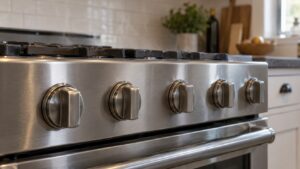
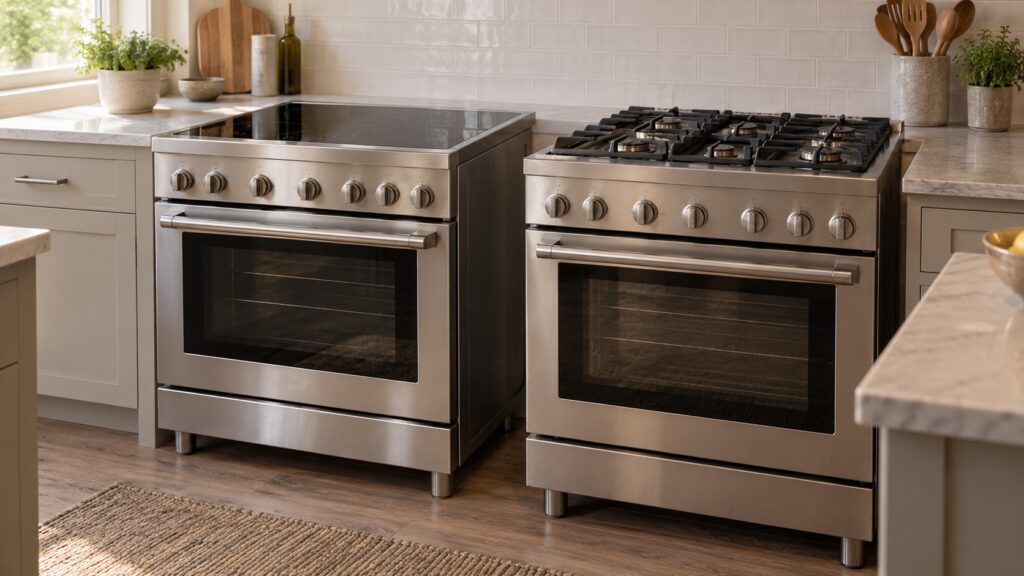
The Bertazzoni induction vs dual fuel range choice is mostly a question of what you want under the pan: a magnetic field that heats the cookware directly, or a gas flame you can see. Both put a fully electric oven below the cooktop on the models on our list, so the real differences are the cooktop, the utilities it needs and the cookware it works with. Choose induction for speed and easy cleaning if your pots are magnetic, and dual fuel if you want a flame and have a gas line.
What is the real difference between a Bertazzoni induction range and a dual fuel range?
It sits entirely in the cooktop. An induction range uses coils under a glass surface to create a magnetic field that heats a pan directly, so the surface stays comparatively cool and the pan responds almost instantly. A dual fuel range keeps a traditional gas cooktop with sealed burners and pairs it with an electric oven. Both can offer a convection oven, a wide choice of finishes and Bertazzoni’s Italian styling, and both belong to the Professional and Master lines on our list.
The model number tells you which you are looking at. Bertazzoni uses IN or IF in the letters of an induction model and DF in a dual-fuel one, which is why MAS365INMXV and MAS365DFMXV are the same width and series with entirely different cooktops. Our Bertazzoni model number decoder explains the rest of the string.
How does cooking feel on each one?
Induction is fast and precise. Water boils quickly, low settings hold steady and a pan lifted off the zone stops heating at once. Cleanup is easier because spills do not bake on a cool surface. The limits are cookware and learning: pans must be magnetic, and some cooks miss seeing a flame. Dual fuel gives the visual feedback of a flame, works with every pan, including a round-bottom wok, and keeps working in the same way it always has, but the surface and grates need more cleaning.
The oven is a separate matter and is electric in both cases on our list, so baking behavior is similar. If you want the oven to be the star, the cooktop choice should not worry you. If you want to know what controls the surface heat, our Bertazzoni range systems guide walks through the main parts.
What do the two types need from your kitchen?
Utilities decide more purchases than taste does. Induction requires a suitable 240 volt circuit and no gas at all, which suits a kitchen without a gas line and avoids a combustion byproduct indoors. Dual fuel requires both a gas line and a 240 volt circuit, since the oven and the igniters use electricity. If you are converting from one to the other, expect electrical or plumbing work. Our guide to Bertazzoni induction rangetop electrical requirements and the range installation checks guide list what to confirm before delivery.
Ventilation deserves a thought too. Gas cooking releases moisture and combustion products, so a strong hood matters more over a dual fuel range. Induction produces none of those, though a hood is still useful for steam and smoke from searing.
Which cookware works, and what are the common surprises?
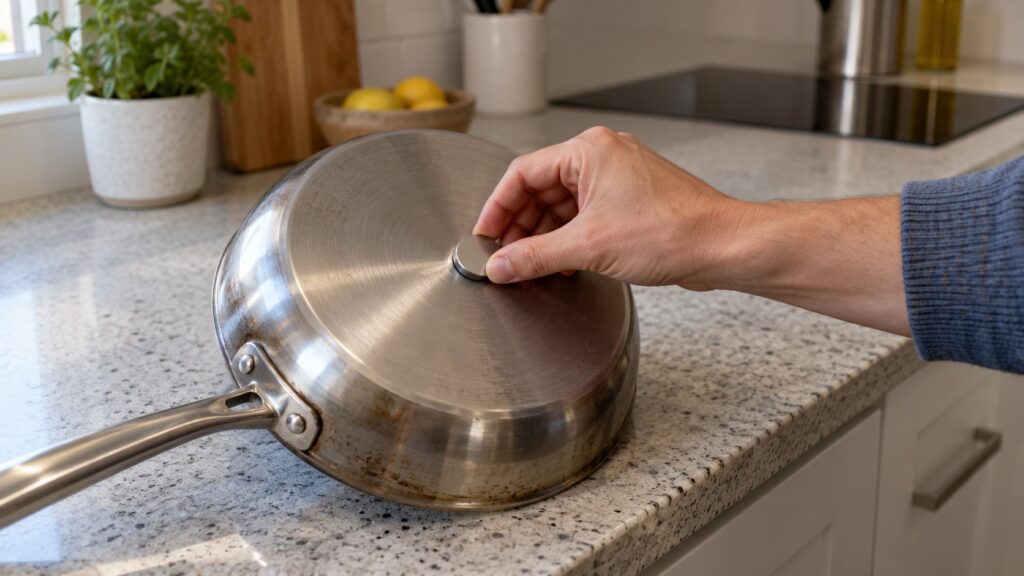
Test your pans with a magnet. If it sticks firmly to the base, the pan will work on induction. Cast iron and most stainless steel pass, while aluminum, copper and glass usually do not unless they have a magnetic layer. A pan that is too small for the zone, or one with a warped base, may not be detected, and then the zone stays off. If that happens on a new range, read our symptom page on an induction zone not detecting a pan before you suspect a fault.
Dual fuel has its own surprises, mostly about care. Burner caps need to be seated correctly, grates are heavy, and igniters need to be kept clean. Our guide to burner caps and cast iron grate care explains the routine, and the dual fuel range faults guide shows how to separate cooktop faults from oven faults.
Which one holds up better over time?
Both are dependable when installed and cared for properly, and the failures are different in kind. Induction cooktops depend on electronics and cooling fans, so their faults tend to be electronic and need diagnosis with meters. Gas burners depend on igniters, valves and clean ports, so their faults are often simpler and can be cleaned or replaced part by part. Neither is fragile; each has its own typical service need.
Consider also what you will tolerate. If you hate cleaning around grates, induction wins. If you want a stove that works with any pot you own, dual fuel wins. Our range versus rangetop and wall oven guide helps if you are not yet sure that a range is the right format.
How can you decide in three questions?
First, do you have or want a gas line? If not, induction settles it. Second, are your favorite pans magnetic, or are you willing to replace the ones that are not? If not, dual fuel is the easier path. Third, how much do you value a quick wipe-down against the sight of a flame? Answer those three honestly and the choice is usually clear without a spreadsheet. Write down the model number of whichever range you pick, since it also tells a technician the fuel type at a glance.