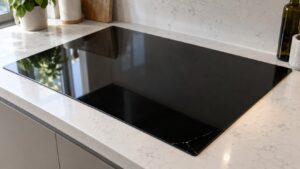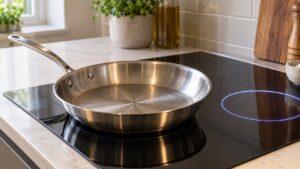
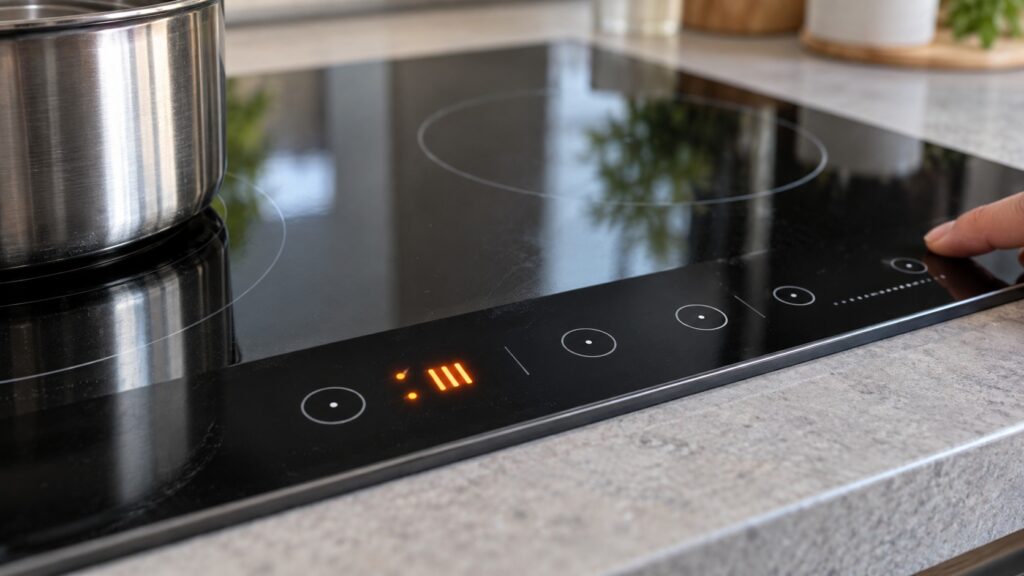
Two of the messages on the PE244HB, PE304HB and PE365HB sheet describe the same piece of hardware: the user interface, meaning the touch control board under the front strip of the glass. ER21 is a user interface overtemperature. ER03 is a user interface obstruction. Neither one is about a coil, a pan or the cooking zones, and neither one is cleared by pressing harder. A Bertazzoni cooktop ER21 is telling you that board got too hot, and ER03 is telling you something is sitting on the keys.
What does ER21 mean on a Bertazzoni cooktop?
An induction cooktop makes its heat in the pan, but the electronics that drive the coils make heat of their own, and so does the pan sitting an inch above the glass. The control board carries a temperature sensor and a limit. Cross the limit and the cooktop stops the zones rather than cooking the board, which is what ER21 reports. It is a protective shutdown, not a broken part, and on a healthy cooktop it should never happen.
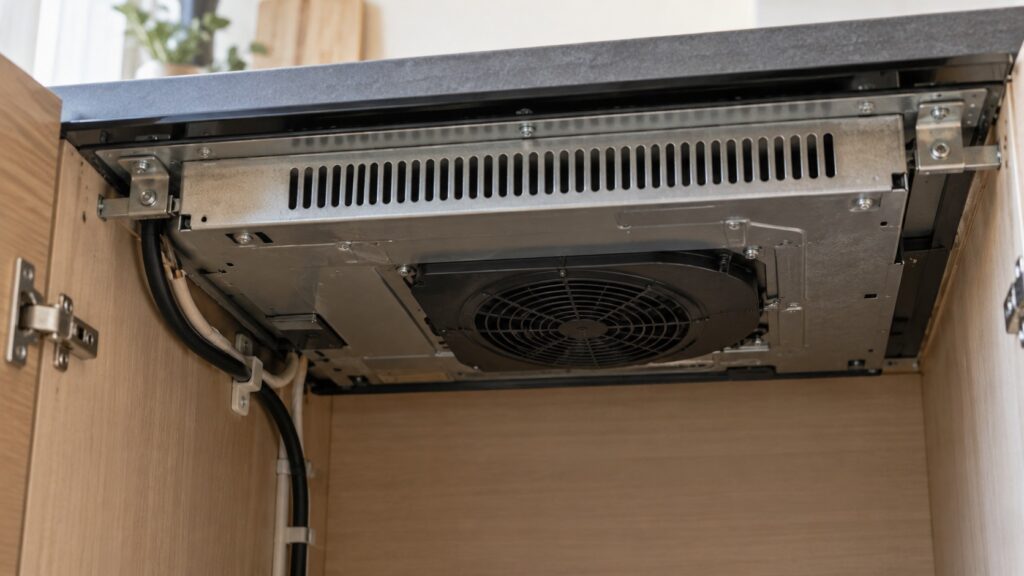
When it does happen repeatedly, the cause is nearly always airflow. These cooktops pull cooling air through a gap at the front or the underside and push it out at the rear, and everything in a cabinet conspires against that: a drawer packed to the top, a false panel fitted without the required cutout, an oven directly below running a self-clean cycle for three hours, or a filler strip closing the ventilation slot during a countertop refit. A single ER21 on the hottest day of the year with every zone on full is plausible. A weekly ER21 means the appliance is not breathing.
What does ER03 mean, and why does it come back?
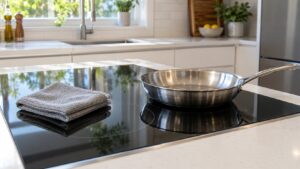
Touch keys work by sensing the small change a fingertip makes to an electric field at the glass. Anything that holds that change steady reads as a finger that never lifts. After thirty seconds or so of it, the cooktop decides the input cannot be trusted and locks out with the obstruction message. The usual culprits are ordinary kitchen life: a puddle of boil-over, a damp dish towel dropped across the front, a pan lid stood on the glass, a plastic chopping board slid down over the controls.
Two less obvious ones are worth knowing. A film of cooking oil that has been wiped rather than cleaned holds moisture against the glass and produces intermittent obstruction messages for weeks. And a cooktop that was set slightly low into the countertop can have the edge of the stone or the sealant bead pressing on the outer key area, so the message returns on humid days and disappears on dry ones.
What can you safely do yourself?
- Take everything off the glass. Pans, lids, cloths, trivets, the mail. Then look again.
- Clean the control area properly. Cooktop cleaner on a cold surface, then a dry microfiber pass. Wiping with a damp cloth and walking away is what causes the repeat.
- Let it cool before you judge an ER21. Give the cooktop half an hour untouched. If it works normally afterward, you are chasing airflow, not electronics.
- Cut power at the breaker for two minutes. Latched messages clear on a restart; a live condition comes straight back.
- Open the cabinet below and look. A blocked ventilation slot, a storage drawer crammed against the underside of the cooktop, or heat coming off an appliance below are all visible without tools.
Do not lift the glass out of the countertop to investigate. The top is bonded to a frame that carries the coils and the mains connection, and on these models the control board sits directly under the area you would be prying against.
How do you tell the two messages apart in real life?
The behavior gives it away long before the code does. An overtemperature shutdown arrives late in a long cooking session, usually with several zones working, and the cooktop is co-operative again once it has stood cold. An obstruction lockout arrives at any moment, often the second something lands on the glass, and it persists no matter how long you wait, because the cause has not moved. If the message appears the instant you switch on a cold cooktop in the morning, it is not heat.
There is a third case that looks like both and is neither: a panel that has gone unresponsive without any message at all. That symptom has its own page on this site, because on gas and induction alike a dead panel with no code usually means the control supply, not the control board.
When is it time to stop and call?
Call when the message survives a clean glass, an empty cabinet and a cold start, because at that point the sensor or the board is reporting something that is not in the kitchen. Call sooner if an ER21 arrives with the smell of hot plastic, or if the cooktop shuts down mid-session more than once a week, since repeated thermal shutdowns shorten the life of everything under the glass. Have the full model number from the underside label ready, because the 24, 30 and 36-inch versions do not share a control board.
We are an independent repair company and not a factory service arm. Pricing starts from a diagnostic visit and we confirm the estimate before any work begins. If the cooktop keeps locking itself out, you can schedule a visit online.
The verified entries live on the ER21 page and the ER03 page. If your panel is dead with no message at all, start from touch controls not responding. The supply-side message from the same family is covered in our guide to the U400 connection fault, and for hands-on work ask for cooktop repair.