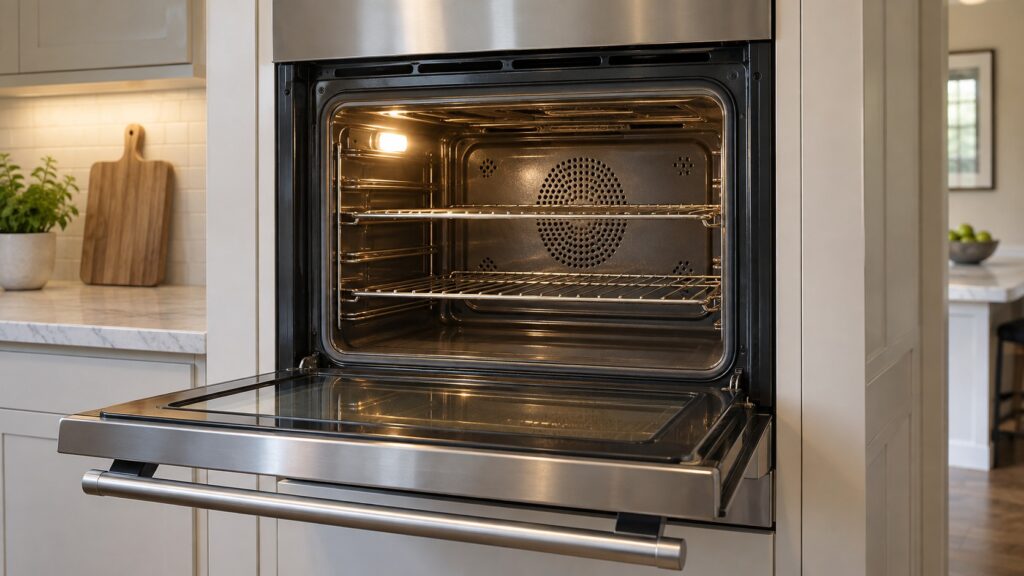
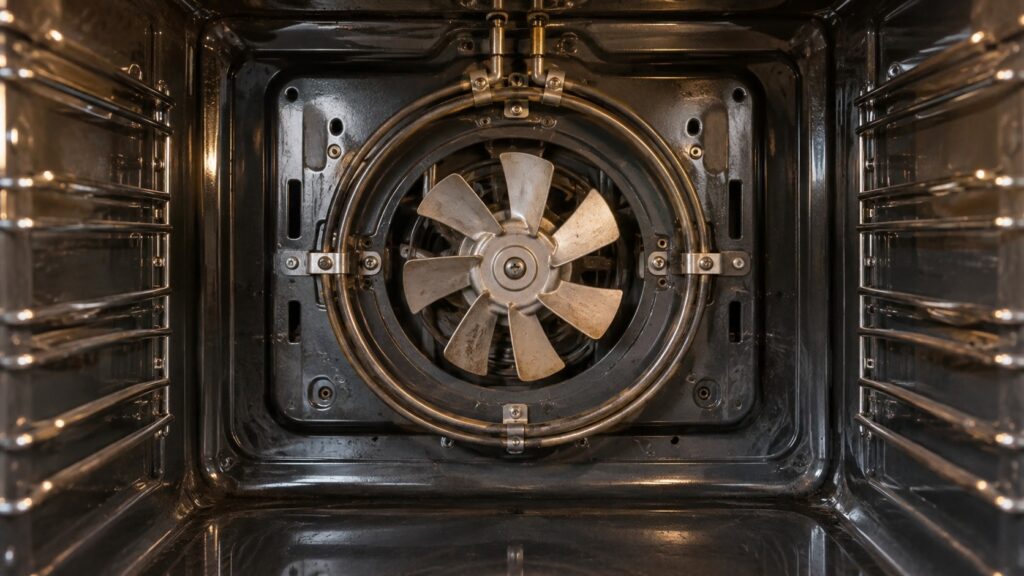
There are two fans in a Bertazzoni oven and they do unrelated jobs, so a complaint about Bertazzoni oven fan noise is really two complaints that need separating before anything is diagnosed. The convection fan lives inside the cavity, behind a perforated back panel, and moves hot air around the food. The cooling fan lives outside the cavity, above the door or behind the control panel, and pushes room air across the electronics and out through a vent. One of them only runs when you ask for convection. The other runs whenever the oven is hot, including for a long time after you have switched it off.
Which fan am I listening to?
Do this test with the oven cold. Set a convection mode and listen with your ear near the door glass: the airy rush behind the glass is the convection fan. Now cancel it, set a regular bake at a high temperature, and wait until the oven is properly hot. The second sound that joins from the top edge of the appliance, at a higher pitch, is the cooling fan. When you switch everything off, the sound that continues is the cooling fan, because the convection fan stops with the mode that called it.
The reason this matters is that the two fans fail differently and cost differently. The convection fan is inside the cavity, which means dismantling the back panel and often the element ring to reach it. The cooling fan is reached from outside the cavity, which is a shorter job on most designs. Telling a technician which fan you can hear is the most useful sentence in the call.
Why does the convection fan get noisy?
A convection fan is a metal blade on a motor shaft in an environment that reaches self-clean temperatures, and almost every noise it makes has a mechanical explanation.
- Rhythmic ticking or scraping. The blade is touching something. A rack pushed too far back, a sheet pan standing on edge, or a piece of foil sucked against the perforated panel will all do it, and so will a blade that has warped slightly after a self-clean cycle.
- A rattle that comes and goes. The retaining nut on the blade has loosened. On most ovens that nut is reverse-threaded, which is exactly why people who try it at home end up tightening it the wrong way.
- A steady grinding whine. The motor bearing. That sound gets worse over weeks and does not improve, unlike every other noise on this list.
- A new noise after a big roast. Grease has reached the blade and dried on one side, putting it out of balance.
What you can safely do is cook with the oven cold and empty, check that nothing is leaning against the back panel, and look for foil or a dropped item behind the racks. What you should not do is unscrew the back panel: the element ring sits immediately behind it, its terminals are live when the oven is on, and refitting the panel out of true guarantees a new noise.
Why does the cooling fan keep running after the oven is off?
Because that is its job. The cooling fan protects the control board, the door hinges and the cabinet around the appliance from the heat still stored in the cavity, and that heat does not disappear when the element switches off. A run of twenty to forty minutes after a normal bake is ordinary, and after a self-clean cycle it can be a great deal longer. An oven built into a tall cabinet next to a refrigerator will run its fan longer than the same oven in an island, because the vent has less room to dump heat.
Two things do make it worth investigating. One is a fan that runs continuously from the moment the oven is plugged in, cold, which points at the thermostat or relay that should be starting it rather than at the fan. The other is a fan that never stops even overnight, because a cavity that stays hot enough to keep it running means the element or its relay is not switching off.
Is a noisy oven fan safe to keep using?
A ticking blade touching a rack is harmless once you move the rack. A bearing whine is a different matter: the same motor drives the blade that keeps the cavity temperature even, and when it slows, baking goes uneven long before the motor stops completely. If your cakes have started rising toward one side in the same oven that has developed a whine, those are one fault and not two.
A cooling fan that has failed silently is the one to take seriously. With no airflow over the controls, an oven cooks its own board and its own wiring insulation, and the damage happens over a handful of long sessions. If the oven is hot and you cannot hear anything at all from the top edge, stop using the self-clean cycle until it has been checked.
When should you book service for oven fan noise?
Book when the noise is a grind or a whine rather than a tick, when it is accompanied by uneven baking, when the cooling fan never starts or never stops, or when a new sound arrives together with a smell of hot insulation. Note which of the two fans it is, when it starts, and whether the oven was in a convection mode, and the diagnosis is mostly done before anyone arrives.
We are an independent repair company and not a factory service arm. Pricing starts from a diagnostic visit and we confirm the estimate before any work begins. If the noise has changed character in the last week, you can schedule a visit online.
The short symptom entries on this site cover a noisy convection fan and a cooling fan that runs too long separately for exactly this reason. The rest of the cavity is described in how the main oven systems work, and hands-on work is oven repair.