A Bertazzoni dishwasher stops a cycle and puts a short letter-and-number message on the display. There are only five of them on the DW24PR and DW24XT control sheets, and each one names the moment the machine gave up rather than the part that failed. E1 is the fill, E4 is water where it should not be, E8 is the valve that steers water between the spray arms, E9 is a key held down, and Ed is the panel losing contact with the board. Read the code as a stage of the cycle and the next step chooses itself.
What does E1 mean on a Bertazzoni dishwasher?
E1 is the fill timer running out. At the start of a cycle the dishwasher opens the inlet valve and waits to measure water arriving. If four minutes pass with nothing measured, it stops and shows E1 rather than heating an empty tub. Nine times out of ten the fault is upstream of the appliance and takes a minute to find: the supply stop under the sink was closed after other plumbing work, the braided inlet hose is kinked behind the machine, or the small screen inside the inlet fitting has silted up with scale and grit.
Work outward from the easy end. Open the stop valve fully, listen at the start of a cycle for the short hiss of the valve opening, and look for a hose pinched against the cabinet rail. If the supply is good and the tub stays dry, the inlet valve itself or the sensor that measures the fill is the next suspect, and that is inside the base of the machine beside mains wiring and the water line. That is where this checklist ends for a homeowner.
What does E4 mean when the tub looks fine?
E4 is the opposite problem and the more urgent one. Underneath the tub there is a shallow steel pan with a float in it. Water that escapes the tub, a hose or a pump lands in that pan, lifts the float, and the machine locks out and runs its drain pump to protect the floor. Bertazzoni dishwashers with this feature will often keep pumping as long as the float is up, which is why an E4 machine can sound like it is running while doing nothing else.
The tub can look perfectly normal with an E4 showing, because the leak is below it. Common sources are a loosened drain hose clamp, a door gasket that has hardened at the bottom corners, and detergent foam forced out of the sump after dish soap went in by mistake. Shut the supply stop, pull the power, and mop what you can reach before the cabinet floor swells. Do not tip the machine forward to drain the pan; that pushes the water into the base wiring.
What is the E8 distributary valve on a DW24XT?
E8 belongs to the DW24XT, and it names a part most people have never heard of. The distributary valve is a motorized diverter in the sump that sends the pumped water to the upper arm, the lower arm, or both, depending on the phase of the wash. The board drives it to a position and expects a feedback signal confirming that position. E8 is that confirmation failing to arrive within the expected time.
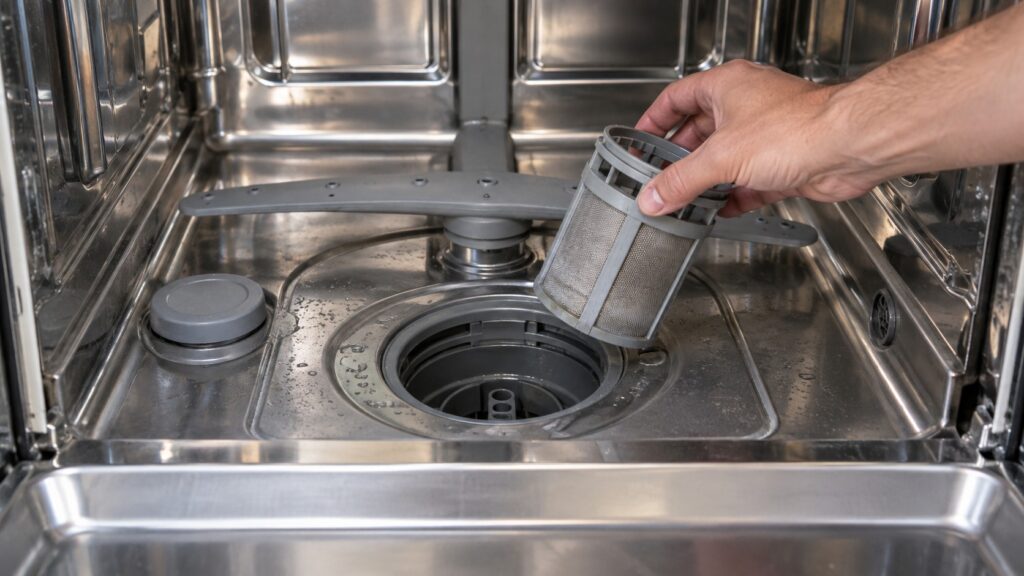
What you notice is usually one half of the load coming out dirty while the other half is clean, or a rhythm change in the wash sound. Before assuming the valve, take out the filter stack and check both spray arms spin freely and that no tall item has been blocking the upper arm, because a jammed arm loads the diverter. Beyond that the sump has to come apart, which is a service job.
Why would a Bertazzoni dishwasher show E9 or Ed?
These two are the control panel rather than the water circuit, and they are the pair people misread most often. E9 means a button has been reading as pressed for more than thirty seconds. A wet finger, a film of grease over the touch keys, or a cabinet panel screwed on too tight against the top edge of the door all produce it. Wipe the fascia dry with a soft cloth, make sure nothing is resting against the controls, and cut power at the breaker for two minutes.
Ed is one level deeper: the display panel and the main board have stopped exchanging data. A single Ed after a power flicker often clears on a restart. An Ed that returns every cycle points at the ribbon connection between the door panel and the base, which flexes every time the door opens and is a known wear point on any dishwasher with the controls in the door edge.
Which Bertazzoni dishwasher error codes can you clear yourself?
- Cut the power for two minutes. Use the breaker, not the door. Codes that were latched by a one-time event clear on restart; a code that reappears immediately is reporting a live condition.
- Open the water stop and straighten the inlet hose. This is the whole fix for most E1 calls.
- Clean the filter stack. Twist out the cylinder filter, rinse the mesh, and check the sump for glass chips and labels.
- Dry the control fascia. E9 is a key, not a board, until proven otherwise.
- Write down the plate. The model string on the tub edge decides which code sheet applies, because E8 is a DW24XT entry and the rest are DW24PR.
Stop before the base panel, the door lock assembly and any hose clamp under the machine. Those sit against mains wiring and the pressurized water line, and a dishwasher that has just shown E4 has standing water down there.
When does a code mean a service call?
E4 on a machine that keeps refilling the pan, E8 after the filters and arms have been cleared, and Ed that returns every cycle are all past the point where more restarts help. So is an E1 on a machine with good supply pressure, because the remaining suspects are the inlet valve and the fill sensor. Bring the full model number and the code to the call and the visit gets shorter.
We are an independent repair company and not a factory service arm. Pricing starts from a diagnostic visit and we confirm the estimate before any work begins. With the model string and the code to hand you can schedule a visit online.
The code pages for DW24PR E1 and DW24PR E4 carry the model scope for each entry, the symptom page for a machine that will not drain covers the case where no code appears at all, and our dishwasher cleaning guide covers the filter and gasket habits that keep E1 and E4 away. If the machine is out of action, dishwasher repair is the service to ask for.