TL;DR: Bertazzoni’s induction rangetop models, including the PROF365IRTXT and MAST365IRTXT, draw far more current than a gas rangetop and need their own dedicated 240-volt circuit sized to the unit’s full load, confirmed before the countertop is cut. Skipping that step is the single most common reason a new induction rangetop trips a breaker or will not power up at all on install day.
Why does a Bertazzoni induction rangetop need different wiring than a gas one?
A gas rangetop only needs electricity for its igniters and any electronic controls — a standard household circuit covers that easily. An induction rangetop has no flame at all; every watt of cooking power comes from electromagnetic coils drawing current directly from the electrical panel, and a full-size rangetop running several zones at high power can pull a genuinely large load. That load has to arrive on a circuit sized for it, on a dedicated 240-volt line, not shared with other kitchen outlets or appliances. This is true of induction cooking generally, and it applies in full to Bertazzoni’s induction rangetop models such as the PROF365IRTXT and MAST365IRTXT, which sit in the range-top appliance category rather than under a wall oven.
What should be confirmed before the countertop cutout is made?
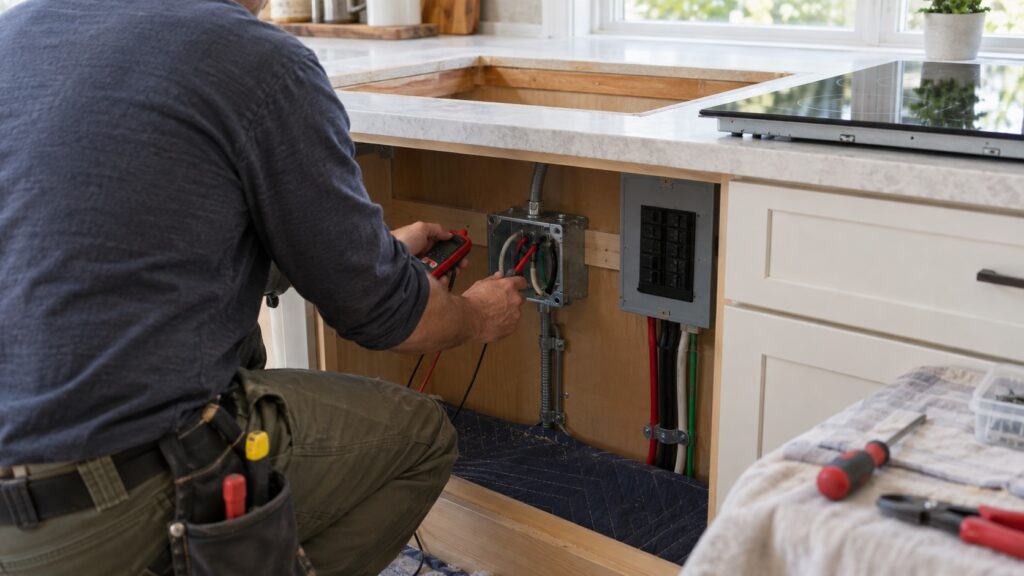
Three things, in order. First, the circuit itself: a dedicated 240-volt circuit sized to the specific model’s rated load, run in wire gauge sized for that amperage, terminating at its own breaker rather than a shared one. Second, the location of that circuit relative to the cutout — moving a 240-volt line after a countertop is already cut is a far bigger job than confirming its position beforehand. Third, the physical clearance beneath the countertop for the unit’s own junction box and cabling, since an induction rangetop’s power connection sits differently than a gas rangetop’s gas-line and igniter wiring did in the same footprint.
What happens if the circuit is undersized or shared?
An undersized circuit shows up almost immediately: the breaker trips when several zones run at higher power settings together, particularly with a large pot on a wide zone and a second zone also running hot. A shared circuit, one also feeding another appliance or a run of outlets, behaves less predictably — it may work fine most of the time and only trip when something else on that circuit draws power at the same moment. Both failures look, at first, like a fault with the rangetop itself, and both cost an installer or technician time ruling out the unit before the wiring gets checked. Confirming the circuit before installation is far cheaper than diagnosing it afterward.
Does the rangetop’s control system need anything beyond the power circuit?
Beyond the dedicated circuit, an induction rangetop needs a level, supported cutout that matches the unit’s specified dimensions and the countertop material’s own installation requirements — stone, for instance, needs different edge support than a laminate surface. It does not need a water line or a gas line the way a gas or dual-fuel rangetop would, which simplifies the rough-in in one respect even as it raises the bar on the electrical side. Ventilation above the rangetop follows the same rules as any cooktop or rangetop installation and is covered separately in our rangetop installation checks guide.
How is this different from installing a Bertazzoni induction cooktop?
The electrical principle is the same — induction cooking draws real power and needs a dedicated 240-volt circuit either way — but a rangetop and a cooktop are different appliance categories on this site for a reason: a rangetop is typically a wider, professional-style unit meant to sit over a full oven cavity or as part of a range-style layout, while a cooktop is a standalone unit installed independently of an oven below it. Our induction cooktop power-connection guide covers the cooktop side of this same electrical principle in more detail, including the specific U400 fault this site tracks for cooktops; a rangetop does not use that same fault code, and the two should not be treated as interchangeable when diagnosing a power problem.
Who should actually run the new circuit?
A dedicated 240-volt circuit sized for a large induction rangetop is panel work, and it should be run by a licensed electrician who can confirm the home’s existing service has the spare capacity to add it safely. This is not a step to shortcut by reusing an existing 240-volt line originally sized for a smaller appliance, such as an older electric cooktop that drew less current than a modern induction rangetop does. The rating plate on the specific model being installed states its required amperage; that number, not a general assumption about “what a rangetop needs,” is what the circuit should be sized against. Pulling that number from the installation manual before scheduling the electrician avoids a second visit if the first circuit run turns out to be undersized for the actual unit ordered.
What should you do if a newly installed induction rangetop will not power on at all?
Before assuming the unit itself is faulty, confirm the breaker has not tripped, confirm the circuit is actually live at the junction box with a meter, and confirm the connection at the rangetop’s own terminal block matches the installation instructions for that specific model. A rangetop that powers on briefly and then shuts down under load points more toward an undersized or shared circuit than toward an internal fault; a rangetop that never powers on at all is more likely a connection issue at the terminal block or a breaker that has not been engaged. Either way, this is worth confirming before a service call, since a wiring issue found at installation is a faster fix than a rangetop shipped back for a fault it never actually had.
We are an independent repair company and do not perform electrical panel work ourselves, but our technicians confirm circuit behavior at the rangetop’s own connection point as part of any induction rangetop diagnosis. Pricing for a visit starts from a diagnostic call, confirmed before work begins. If your PROF365IRTXT, MAST365IRTXT, or similar induction rangetop will not power on after installation, schedule Bertazzoni rangetop repair or book a visit directly.