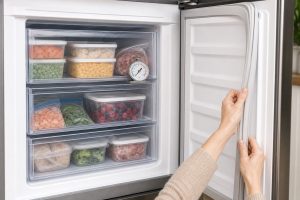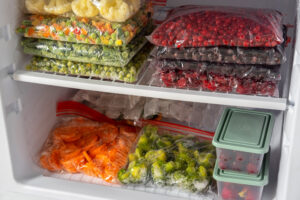

Bertazzoni freezer terms are the words you meet on a built-in freezer column or drawer: compressor, condenser, evaporator, defrost, frost, ice maker, door alarm and temperature alarm. This glossary explains what each one means in general terms, so that a symptom or a message makes sense before you call anyone. What each term does on your exact model, and how its alarm or setting appears, is set out in your owner’s manual and on the rating label.
What is the difference between a freezer column and a freezer drawer?
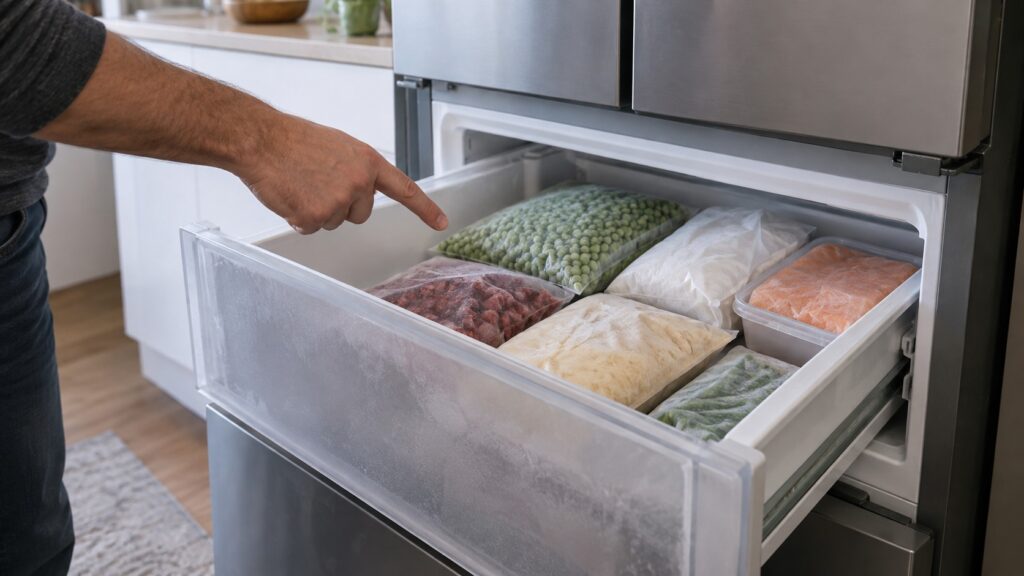
A freezer column is a tall, narrow freezer that stands in a cabinet run and opens like a door, usually with shelves and baskets inside. A freezer drawer pulls out like a drawer and is often installed lower down. Both are built-in freezers. Our site lists freezer models such as the REF18FCBIPRV. We do not decode the letters in model names, so which format a given model is comes from its rating label and manual.
Format matters to you for practical reasons: how you load it, how air reaches the coils and where the hinge and clearance sit in the cabinet. Our freezer installation checks that prevent faults guide covers clearances and leveling.
What do compressor, condenser and evaporator mean?
These three parts do the main work of cooling. The compressor circulates refrigerant, the evaporator inside the freezer absorbs heat from the food and the air, and the condenser releases that heat to the room. When any of them is not doing its job, the freezer warms up. You do not need to understand the physics, only the symptom: a compressor that runs constantly or a condenser that is dusty or blocked by a cabinet panel makes the freezer work harder. Our symptom page on a compressor that runs constantly explains what to note.
Our freezer how the main systems work guide gives an overview of the same parts. None of them is an owner repair; the sealed system in particular is technician work.
What are frost, defrost and no-frost?
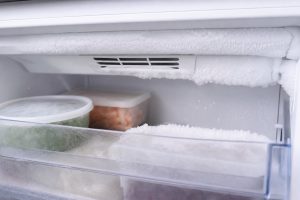
Frost is the ice that forms on cold surfaces when moist air gets in, for example when the door is opened often or does not seal. Defrost is the routine that melts it. In a manual-defrost freezer, you empty and thaw it yourself. In a no-frost, or auto-defrost, freezer, a defrost routine runs on its own, so you should not see thick frost build up. A freezer that shows heavy frost where it should not usually has a door seal, a drain or a defrost problem; see our page on heavy frost. Which type your Bertazzoni freezer is, and how its defrost routine behaves, is a question for the manual for your model, because our site does not state it.
What are the gasket, the setpoint and the fan?
The gasket is the flexible seal around the door. A torn or dirty gasket lets warm, moist air in, which is a common source of frost and of a compressor that never rests. Wipe it gently with a mild soap solution as your manual allows and check that it sits flat. The setpoint is the temperature you choose on the control, and your manual says how to change it and what range is allowed. Do not keep turning it colder to fix a symptom, because a freezer that is set colder but cannot hold the temperature has a fault that the setting will not cure. The fan, where fitted, moves cold air across the evaporator and around the cabinet; a fan that is noisy or silent is described on our page for freezer fan noise. For routine care of all of these, see our freezer cleaning and maintenance guide.
What do the door alarm and temperature alarm mean?
A door alarm sounds when the door has been open or not fully closed for a while. Close the door properly and check that nothing, such as a basket, keeps it from latching. A temperature alarm tells you the inside has warmed above a safe level. Our pages on door alarm and high temperature alarm describe both. For food safety, the FDA treats 0 °F as the freezer temperature for keeping food; if a freezer stops working, keep the door closed, since a full freezer holds its temperature for about 48 hours and a half-full one for about 24 hours, according to the FDA. Check your food against the FDA’s guidance, not by smell.
What is the ice maker and what does it need?
If your freezer includes an ice maker, it fills a mold with water from the house supply, freezes it and drops the ice into a bin. It needs a working water line and a freezer cold enough to freeze the water. When ice stops, the cause can be the water supply, the mold, a frozen fill tube or the cold itself; our page on ice maker stopped lists what to note. Not every freezer has an ice maker, so check your model.
When does a term mean call a technician?
Call when the freezer will not freeze, the alarm keeps returning after you close the door, there is heavy frost, water under the unit or a compressor that never stops. If water reaches an outlet, switch off the breaker at the panel while standing on a dry floor and do not pull a plug out of a wet outlet. Do not remove panels to reach the coils or the evaporator. Our Bertazzoni freezer repair page explains how a visit works, and our freezer model number and rating plate guide shows what to have ready.