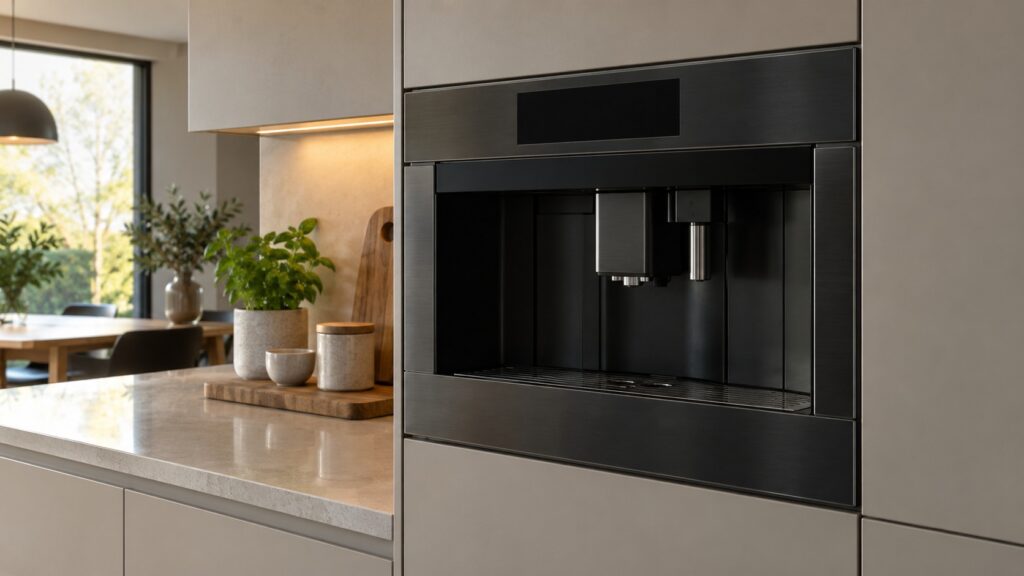
Bertazzoni coffee machine terms are mostly the same words used for any built-in bean-to-cup coffee maker: the grinder, the brew unit, the water container, the pump, the heater, the milk system, the drip tray and the descale and rinse messages. Our service page describes these as 24-inch built-in bean-to-cup coffee makers, so this glossary explains what each part is and why it matters in general terms. What each term does on your exact model, and how its message appears on the display, is set out in your owner’s manual.
What does bean-to-cup mean on a Bertazzoni coffee machine?
Bean-to-cup means the machine does every step itself. You fill a hopper with whole beans and a container with water, choose a drink, and the machine grinds the beans, doses the grounds, brews the coffee and, on many models, froths milk. A capsule or pod machine skips the grinding and the dosing because the coffee is already measured. Because a bean-to-cup machine does more work inside, it has more parts to keep clean, and that is why most of the other terms in this glossary describe a part or a message about care rather than a setting.
Bertazzoni lists its built-in coffee maker under the Professional, Master and Heritage series on our site. For the model we cover, see the page for the CM242WTXT. We do not decode the letters in a model name, so check the rating label and the manual for what yours supports.
What are the grinder, the hopper and the brew unit?
The hopper is the container on top that holds the whole beans. The grinder sits underneath it and crushes the beans just before brewing, which is why a grinder that sounds rough or loud is worth noting. Oily beans and small stones or foreign pieces among the beans are a common reason a grinder labors. Our symptom page on a noisy grinder explains how to describe it to a technician.
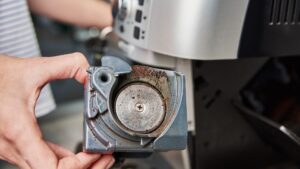
The brew unit is the compartment that receives the ground coffee, presses it into a puck and lets hot water pass through. On many machines the owner can take the brew unit out to rinse it, but how it is released, and whether it can be removed at all, depends on the model. Follow the manual. If the unit sticks or will not come out, do not force it: read our page on a stuck brew unit and our guide on brew unit repair or replace.
What do descale, rinse and water hardness mean?
Water leaves mineral scale, mainly limescale, inside any appliance that heats it. Descaling is the process of running a descaling solution through the machine to dissolve that scale. A descale message is the machine reminding you that it is time to do this. Rinsing is a short flush of water through the system, often when the machine starts up or shuts down, and it clears coffee residue from the spout and the internal path. Water hardness describes how much mineral your tap water carries; harder water builds scale faster, so a machine in a hard water area asks for descaling more often.
The intervals, the product to use and the exact steps belong to your manual, and we will not give a number here. If the message keeps coming back after you have descaled, see our guide on a descale message that keeps returning and the symptom page for descale message returns.
What are the pump, the heater and the water path?
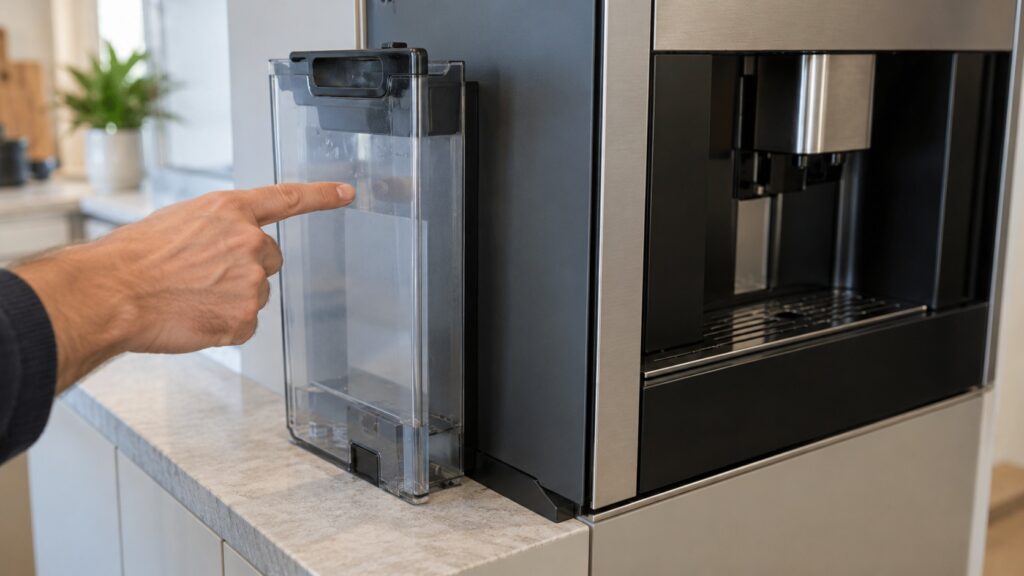
A pump moves water from the container through the machine, and a heater brings it to brewing temperature. Together with the valves and tubing, these make up the water path. When the water is not flowing, or the coffee comes out cold, the fault is usually somewhere along this path: a blocked inlet, an empty or badly seated container, scale or a failed part. The first two you can check yourself; the rest need a technician, because the parts are inside the cabinet next to the mains supply and the water line. Our pages on water is not flowing and coffee is too cold describe each symptom.
We use the word heater loosely on purpose. Some machines use a boiler, some a small flow heater, and our site does not tell us which one a given Bertazzoni uses. The manual for your model will say.
What do the milk system, drip tray and grounds container do?
The milk system, where fitted, draws milk through a short tube and froths it with air and steam. Milk residue dries and clogs the narrow passages, so it needs cleaning as your manual describes; a milk system that does not froth is covered on our page for milk does not froth. The drip tray catches rinse water and spills, and the grounds container collects the used pucks. A full container or an unseated tray can block the machine from brewing on some models, so empty both before you look for a fault.
For a regular routine, read our coffee machine cleaning and maintenance guide. For an overview of how these parts fit together, see how the main systems work.
Which terms mean call a technician?
A few phrases should stop you. Water on the floor or inside the niche, a burning smell, a sparking sound, a display that stays dark or a breaker that trips are all reasons to switch the machine’s breaker off from a dry spot and call. If there is water near the outlet, stand on a dry floor when you reach the panel and never pull a plug out of a wet outlet. Do not take panels off the machine or reach into the housing; those are technician jobs. Our Bertazzoni coffee machine repair page explains how a visit works.