
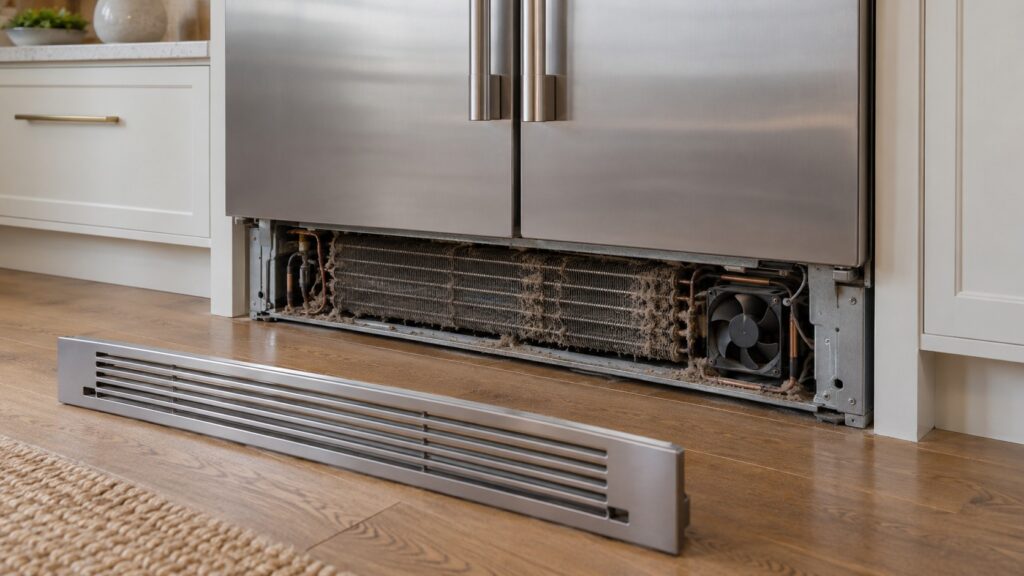
The Bertazzoni refrigerator condenser fan pulls room air across the condenser coils so the sealed system can dump the heat it removes from the food compartment, and keeping the fan and coils free of dust is the most useful maintenance you can do on a built-in or panel-ready model. A fan or coil choked with lint makes the refrigerator run longer, get louder and cool less well, and it is the first thing we check when an otherwise healthy refrigerator drifts warm.
What do the condenser coils and fan do in a Bertazzoni refrigerator?
Refrigeration moves heat from inside the cabinet to outside it. The compressor pushes refrigerant through the condenser coils, where the heat leaves the refrigerant and goes into the surrounding air. A fan helps by drawing room air across the coils, and when that air flow is good, the system finishes its work quickly and shuts off. When the flow is poor, heat lingers in the coils, the compressor runs longer and temperatures inside the cabinet creep up.
On a built-in or panel-ready refrigerator, the coils and the fan are usually tucked low in the unit, behind a front grille, so air enters and leaves through the front rather than the back. That arrangement is what lets these refrigerators sit flush against cabinets, and it is why a blocked grille matters so much. Our Bertazzoni refrigerator systems guide places the condenser in the context of the other main parts.
How can you tell the fan or coils need attention?
Look for a pattern. The compressor and fan run for long stretches without resting, the refrigerator feels warmer than usual, the sound has changed to a buzz, hum or rattle, or the area around the lower grille feels hot. Food that spoils earlier than before is also a clue. If the fan blades are not turning when the compressor is running, or turn slowly, the fan itself may have failed instead of just being dirty.
Our symptom pages on a noisy refrigerator fan, a refrigerator that runs constantly and a refrigerator that is not cooling all list the condenser among the causes worth checking early, since it is cheap to rule out.
How do you clean the condenser area safely?
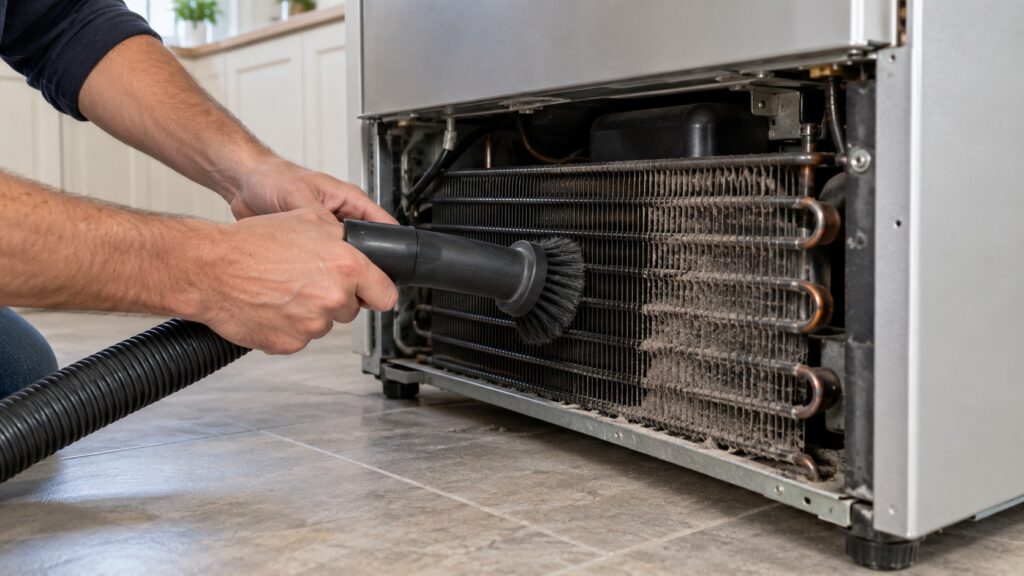
Start by unplugging the refrigerator or switching off its circuit, since you will be near the fan. Remove the lower front grille by following your manual; on many models it unclips or lifts off. Use a vacuum with a soft brush attachment to pull dust from the grille, the coils and the area around the fan, and a long soft brush or a coil cleaning brush to reach between the fins. Work gently in the direction of the fins. Do not use compressed air in a way that blows dust into the motor, and never use water or a wet cloth on the coils or the fan.
The fins are thin and bend easily, and bent fins block air as well as dust does. If you bend some, a fin comb is the usual tool, but stop if you are unsure. When you finish, check that the fan blades spin freely by hand with the power off, restore power, and listen to the sound. A clean condenser typically makes a calmer, steadier hum. For the rest of the routine, see our Bertazzoni refrigerator cleaning and maintenance guide.
What about clearance, the grille and the surrounding cabinet?
Cleaning is wasted if the airflow is blocked by the installation. A built-in refrigerator needs the clearances in its installation instructions at the top, sides and front, and the grille must not be covered or restricted by trim, a panel or boxes stored in front of it. A panel-ready model carries a custom panel on the door, but the ventilation openings still have to stay open. If the refrigerator was installed in a tight space and has run warm since day one, the clearances are the first thing to review. Our refrigerator installation checks list them.
Room conditions matter as well. A kitchen that gets very hot in summer, or a refrigerator beside an oven or a sunny window, puts extra load on the condenser. Moving heat sources away or improving ventilation helps the refrigerator more than any amount of cleaning. After a heat wave, a power cut or a long trip, give the unit a day to settle before you judge its temperature, and check the thermometer rather than relying on how the food feels.
When is the fan itself the problem?
If the coils are clean, the airflow is clear and the refrigerator still runs warm, listen to the fan. A fan that squeals, grinds, clicks or does not turn at all has a worn motor or a blocked blade, and replacement is a job for a technician who can confirm the part for your exact model. Do not run a refrigerator for long periods with a dead condenser fan, because the compressor can overheat. If you are deciding whether a repair makes sense on an older unit, our refrigerator repair or replace decision guide sets out how to weigh it.
Give your technician the model number and describe the sound and the timing. Our refrigerator troubleshooting checklist shows what to note before the visit.