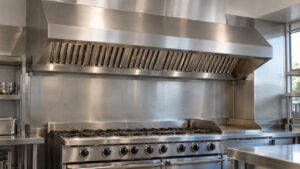
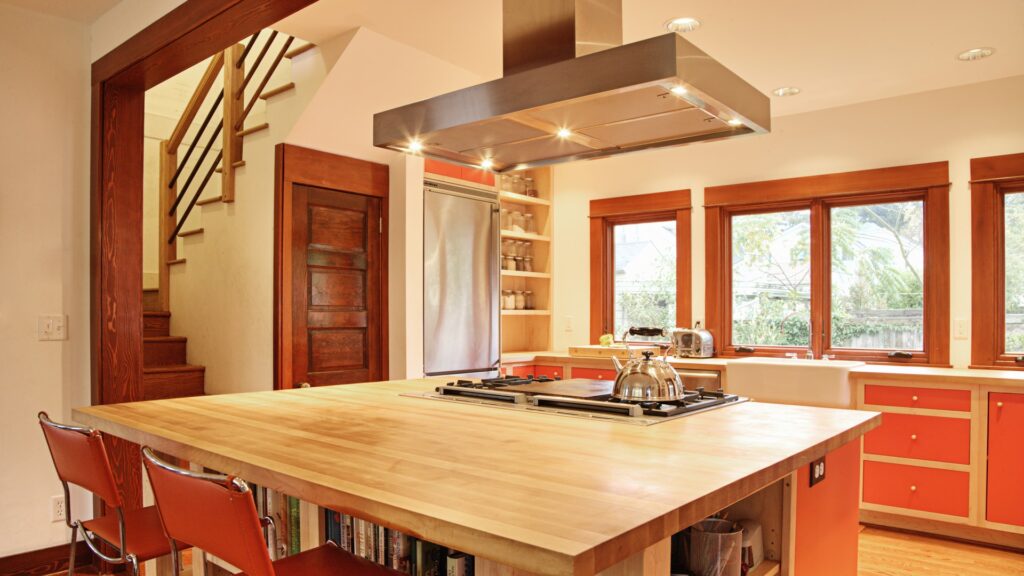
Bertazzoni range hood airflow is quoted as a single number in cubic feet per minute, and that number describes the fan in a test rig, not the hood over your cooktop. What arrives in your kitchen is whatever survives the duct, the bends, the cap outside and the air the house is able to replace. Understanding where the difference goes explains both how to choose a hood and why a perfectly healthy hood sometimes fails to clear steam.
What the fan actually does
A hood motor drives an impeller — a wheel with curved blades — inside a housing. Spinning, it throws air outward and creates a low-pressure region at its center, and kitchen air moves in to fill it. That is the whole mechanism. Everything else in a hood’s design exists either to get vapor to the impeller or to get it away afterward.
Two impeller types appear. A centrifugal blower moves air well against resistance and is what ducted hoods use. An axial fan, like a desk fan, moves more air with no resistance but collapses quickly when a duct is added. The distinction matters because a hood’s rating always assumes its own type of test, and a recirculating hood’s number is not comparable with a ducted one’s.
Where the rated number goes
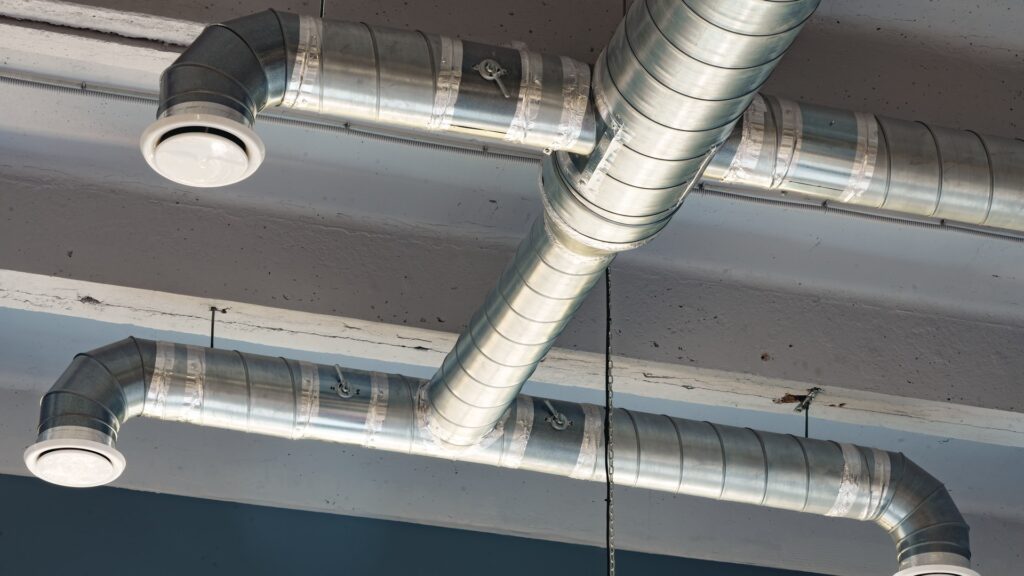
Air moving through a duct loses energy to friction and turbulence. The industry calls that static pressure, and each element of a run adds some:
- Length. Straight duct costs little per foot, but it accumulates on a long run to an outside wall.
- Elbows. Each ninety-degree bend costs roughly as much as many feet of straight duct. Two tight bends near the outlet cost more than a longer, gentler route.
- Reductions. The most expensive mistake. A hood with an eight-inch outlet connected to six-inch duct is throttled at the source, and no setting recovers it.
- Flexible duct. Corrugated flex has many times the resistance of smooth rigid duct, and it is frequently left slack, which adds more.
- The wall or roof cap. A cap with a fine mesh screen or a stiff damper can cost a surprising share of the total, and it is the element most often clogged with lint and insects.
The practical result: a hood rated at 600 CFM on a poor run may deliver less than half of that, while a modest hood on a short, straight, correctly sized run outperforms it. Our page on installation checks covers what to verify in an existing run.
Capture area: the part no number describes
A hood that cannot intercept the plume cannot extract it, whatever the fan is doing. Three geometric facts decide this:
Width. A hood should be at least as wide as the cooking surface, and wider is better. A thirty-inch hood over a thirty-six-inch range leaves the outer burners uncovered, and the vapor from them rises outside the capture area.
Depth. The hood needs to cover the front burners, not only the back ones. Shallow hoods are a compromise made for headroom and they make the rear burners the only ones properly served.
Height. Too high and the plume spreads before it arrives; too low and it is a hazard and impedes cooking. The manufacturer’s stated range is a real specification, and hoods installed above it perform measurably worse.
Make-up air, and the house as part of the system
Every cubic foot a hood pushes outside has to be replaced by a cubic foot entering from somewhere. In an older, leaky house it arrives through the building fabric unnoticed. In a modern airtight one it cannot, and the hood works against a growing negative pressure — moving less air than it should, whistling at window seals, and in the worst case disturbing the draft of a fuel-burning appliance elsewhere in the house.
That is why high-extraction hoods are paired with a make-up air system in many jurisdictions, and why a powerful hood retrofitted into a tight house can underperform a weaker one. It is a building question, not an appliance fault, and it is worth identifying before anyone starts replacing motors.
Recirculating hoods, measured honestly
Where ducting outside is impossible, the hood filters and returns the air: grease filters first, then charcoal for odor, then back into the room. It captures grease effectively and reduces odor while the charcoal is fresh. It does not remove heat or moisture, and its effective airflow is lower than the same hood ducted, because the filters are themselves resistance.
Charcoal is a consumable with a life measured in months and it gives no warning. A recirculating hood that still moves air normally but has stopped controlling odor almost always needs that filter, not a repair. The site’s cleaning and maintenance guide covers the schedule for both filter types.
When airflow drops on a hood that used to work
When to call
Call when airflow has dropped with clean filters, when the motor is noisy or vibrates, when the hood runs at one speed only, when lights or controls stop responding, or when a new installation is not clearing steam and you want the duct run assessed rather than the appliance replaced.
We are an independent repair company and not a factory service arm. Pricing starts from a diagnostic visit and we confirm the estimate before any work begins. Bertazzoni range hood repair covers motors, controls, lighting and ducting, and you can schedule a visit online.